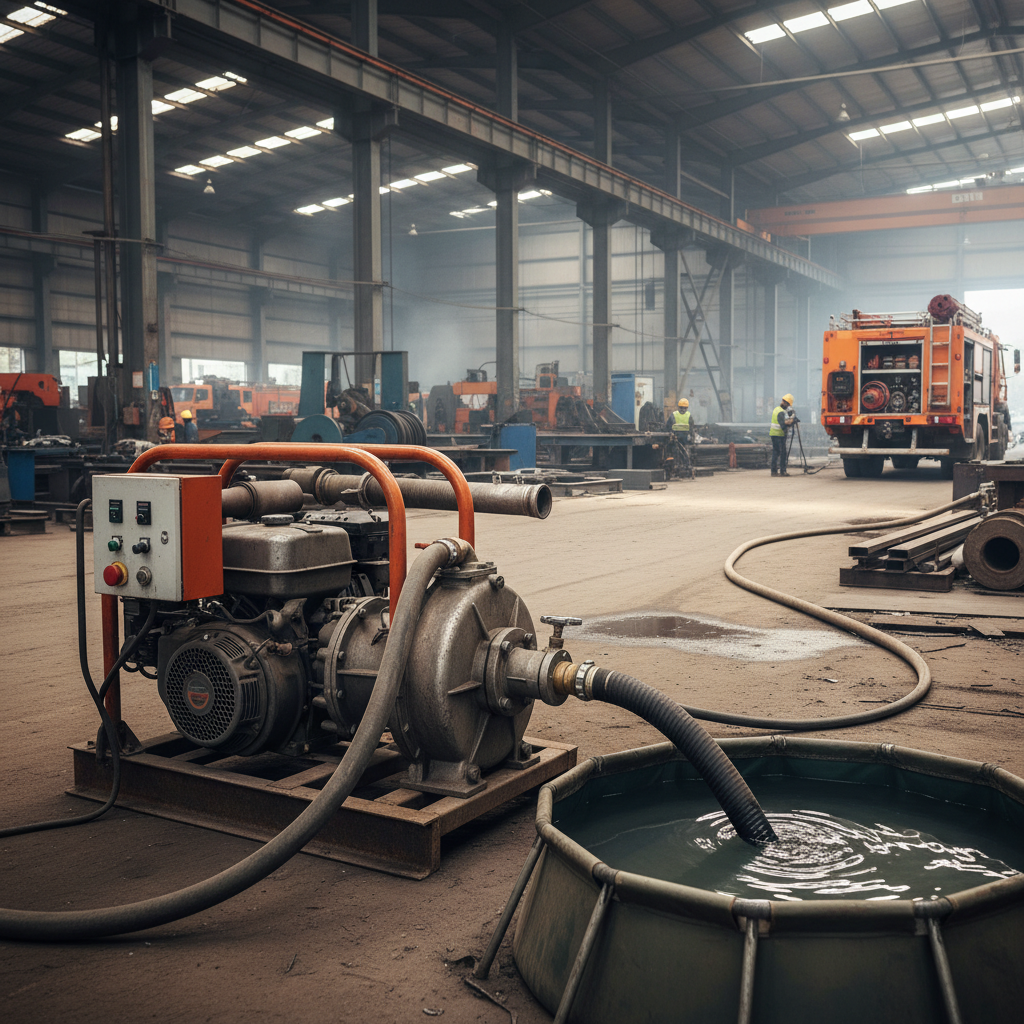







Securing emergency response capabilities often involves a difficult balance between operational performance and budget constraints. For many fire departments and forestry services, finding cheap fire fighting pumps that do not sacrifice essential pressure or durability is a critical challenge in the safety and security equipment manufacturing sector.
The primary difficulty lies in the "cost-performance trap," where low-priced equipment often fails during high-elevation pumping or remote watering operations due to inferior seal materials or engine instability. Procurement officers need a way to distinguish between truly cost-effective engineering and equipment that creates a liability in the field.
This analysis provides a framework for evaluating budget-friendly pumping solutions, examining the technical trade-offs of portable units, and offering a decision matrix to ensure that affordability does not compromise firefighting safety.

Defining Cost-Effectiveness in Fire Pumps

In the context of firefighting equipment, "cheap" should not be synonymous with "low quality," but rather with "optimized value." A cost-effective pump is one that meets the minimum required flow rate and head pressure for a specific application—such as forest fire suppression—without paying for unnecessary industrial-grade features that the user will never employ.
For instance, a portable pump utilizing a 2-stroke engine and aluminum alloy components can significantly reduce the initial purchase price compared to heavy diesel units, while remaining lightweight enough for rapid deployment in mountainous terrain. The value is found in the alignment between the tool's capability and the actual demand of the environment.
Core Specifications for Budget-Friendly Units
When evaluating cheap fire fighting pumps, buyers must look past the price tag and analyze the mechanical architecture. A reliable entry-level professional pump often features a 3-stage pump end paired with a forced air-cooled engine. Key parameters to monitor include the suction lift (typically around 7m for portable units) and the maximum lift, which determines the pump's ability to push water up steep inclines.
Materials play a decisive role in both cost and longevity. The use of anodized aluminum alloy for pump components reduces weight and resists corrosion, which is vital for equipment stored in humid or outdoor conditions. Additionally, the inclusion of sealed bearings and blister-resistant mechanical rotary seals prevents the need for constant field greasing, reducing operational downtime.
Operational Applications for Portable Pumps
Budget-oriented portable pumps are most effective in scenarios where agility outweighs massive volume. Attack-line firefighting in wildland areas is a primary use case, where a pump with a flow rate of approximately 380L/min provides sufficient coverage for initial containment without the need for heavy vehicle support.
Beyond direct attack, these units are invaluable for long hose lay operations. Because they can be used in tandem—where one pump feeds another—they allow firefighters to move water over long distances or to high elevations in mountainous regions. This modularity allows agencies to scale their capabilities by purchasing multiple affordable units rather than one prohibitively expensive high-capacity system.
Analyzing Performance vs. Price Relative Value
To understand the value proposition of budget-friendly pumps, we can look at a normalized relative performance index. This illustrative framework compares the operational utility of various pump classes against their relative cost, demonstrating where the "sweet spot" for value typically resides for forestry and emergency rescue applications.
The data suggests that portable 2-stroke units provide the highest relative utility per dollar spent for rapid-response wildland firefighting. While high-capacity vehicle-mounted pumps offer more power, their cost-to-utility ratio for small-scale, remote attacks is significantly lower due to their lack of portability and higher acquisition cost.
Evaluating Total Cost of Ownership
The initial purchase price of cheap fire fighting pumps is only one part of the financial equation. A truly economical choice is measured by the Total Cost of Ownership (TCO), which includes fuel consumption, maintenance intervals, and the cost of replacement parts. A pump with a belt-drive system, for example, often proves cheaper over time due to lower maintenance requirements compared to complex gear-driven systems.
Furthermore, the ability to replace the pump end independently of the engine is a critical cost-saving feature. Quick-release clamps and detachable ends allow for infield replacements, meaning a damaged pump head doesn't render the entire engine useless, effectively extending the lifecycle of the primary investment.
Risk Mitigation in Low-Cost Procurement
The primary risk when sourcing affordable equipment is the compromise of safety standards. Buyers should avoid units that lack a clear technical specification sheet or those that use generic, non-replaceable seals. In high-pressure environments, a seal failure can lead to immediate loss of water flow, potentially endangering personnel on the fire line.
To mitigate this, procurement should focus on manufacturers who specialize in comprehensive emergency rescue equipment. Suppliers who can provide a full ecosystem—including portable water tanks, fire pump fittings, and personal protection suits—typically have a more integrated quality control process than those selling standalone, generic hardware.
Strategic Selection Framework
Choosing the right pump requires matching the technical capability to the specific environment. The following table provides a qualitative comparison between different budget-friendly approaches to firefighting water delivery to help decision-makers select the most appropriate tool for their operational needs.
| Pump Type | Primary Strength | Best Use Case | Main Limitation |
|---|---|---|---|
| Mini Portable | Extreme Mobility | Small brush fires | Low volume |
| Standard Portable | Balanced Value | Wildland attack | Fuel capacity |
| Tandem-Capable | High Elevation | Mountainous terrain | Setup complexity |
| Vehicle-Mounted | Sustained Flow | Urban interface | Limited access |
| Knapsack Mist | Precision Spotting | Mop-up operations | Manual effort |
| Mobile Diversion | Water Access | River/Lake drafting | Weight/Bulk |
Ultimately, the most effective "cheap" pump is the one that provides the exact performance required for the mission without over-engineering. By prioritizing critical specs like maximum lift and seal durability over brand prestige, agencies can maximize their protective coverage within a limited budget.
Frequently Asked Questions
The maximum lift (head pressure) is critical, as it determines if the pump can effectively push water up slopes or through long hose lays in remote firefighting scenarios.
Yes, many professional portable units are designed for parallel pumping to increase the total volume of water delivered to a slip-on unit or a larger manifold.
2-stroke engines typically reduce the pump's weight and initial cost, making them ideal for hand-carried operations, though they require a fuel-oil mix.
Look for anodized aluminum alloys for the pump body and blister-resistant mechanical rotary seals to prolong the life of the pump end.
Yes, provided they are used in tandem. Linking multiple pumps allows the water to be pushed to much higher elevations than a single unit could manage.
Choose pumps with sealed bearings to eliminate field greasing and detachable pump ends that allow for quick replacement of worn components.
Conclusion
Procuring cheap fire fighting pumps does not have to mean compromising on operational readiness. By focusing on a 3-stage pump architecture, aluminum construction, and the ability to operate in tandem, agencies can build a flexible and powerful water delivery network without excessive capital expenditure.
For organizations evaluating the balance between budget and performance, detailed product specifications and application-specific configurations are available at www.ffwfiresafety.com to assist in making an informed procurement decision.